
Jefferson County Projected Versus Actual Release
“Projected release date” is a useful search phrase, but it is not the exact label documented in Missouri’s public corrections data. MODOC’s Sunshine layout uses Sentence-I Minimum Release Date and Sentence Maximum Release Date. The agency glossary defines the minimum release date as the conditional-release date and the maximum release date as expiration of the full term. Preserve those names when reading or requesting a state record.
A projected or minimum date describes a calculated point under the current sentence facts. The actual release is the event when the custodian stops holding the person. Those dates can differ because of a Board decision, discipline, another sentence, a detainer, a court order, or a change in credited time. The release timestamp confirms departure from one custodian, but a transfer may place the person immediately in another agency’s control.
Scheduled versus actual: a calculated date can change. Only the releasing agency’s event record confirms when the person physically left that custody.
A pretrial detainee has no sentence-based release date. Bond may be posted, charges may change, and other holds may block departure. A court order is also not the same as the later jail release timestamp. For a recent Jefferson County Jail departure, the JCSO release record is the affirmative source.
Find Jefferson County Inmate Release Dates
Begin with the custody type. A local jail calculation belongs with JCSO and the sentencing court. A Missouri prison calculation belongs with MODOC. The public MODOC Offender Search is a starting point for active offenders, prisoners, parolees, and probationers, but its landing page does not document a field literally called “Projected” or “Tentative Release Date.” It also excludes fully discharged people.
- Obtain the judgment, sentence length, offense date, and whether terms run at the same time or one after another.
- Confirm all certified presentence jail credit and the custodian that holds the person now.
- For state custody, search the active MODOC record and match the DOC number, birth date, offense, case, and assigned location.
- Read every relevant charge row in the MODOC Sunshine data, using the exact minimum and maximum release-date labels.
- Ask the institutional caseworker or Parole Board about the current calculation and any presumptive decision.
- For a county jail sentence, ask JCSO or the sentencing court for the recorded calculation instead of applying a state-prison formula.
- Confirm the final event through the release record and the receiving agency if a transfer occurred.
The Jefferson County release-search paths help locate the current JCSO roster, recent release timestamp, court file, and older records-request route. These sources answer different parts of the timeline. Do not make a no-result in one system carry the meaning of all the others.
Jefferson County Jail Credit
RSMo § 558.031 addresses qualifying time already spent in prison, jail, or other custody on the related matter. A sentence begins when the person is received into DOC or other sentenced confinement, and the Sheriff certifies qualifying presentence custody credit. Escape interrupts sentence service and credit. This credit recognizes time already confined. It is not a reward for good conduct.
For a Jefferson County jail sentence, start with the judgment and the local computation. The research found no official Jefferson County policy establishing a local good-time formula or a weekend-advance rule. That absence matters. A state-prison percentage should never be imposed on a local jail term without authority. Ask JCSO at 636-797-5081 or the sentencing court for the date and calculation entered in the actual record.
Concurrent and consecutive sentences also change the result. Concurrent terms run together to the extent ordered. Consecutive terms run in sequence. A single case screen can therefore be incomplete if another cause number or hold affects custody. Certified jail credit must also be tied to the qualifying matter rather than assumed to reduce every sentence.
Jefferson County Conditional Release Terms
For an ordinary eligible term-of-years felony sentence, RSMo § 558.011.4 divides the sentence into prison and conditional-release portions. Terms of nine years or less have a conditional-release portion of one-third. Terms above nine through fifteen years have a three-year portion, and terms above fifteen years have a five-year portion. The rule has exclusions and must be applied to the actual sentence.
Conditional release is community discharge by Parole Board order under Probation and Parole supervision. It does not erase the unexpired sentence. The Board can extend the conditional-release date through the statutory process, potentially up to the full term. Dangerous felonies and certain repeat remands are outside the ordinary structure. Other sentences, holds, violations, rescissions, and credits can also change the date.
The official conditional-release statute supplies the controlling portions shown in the captured source.
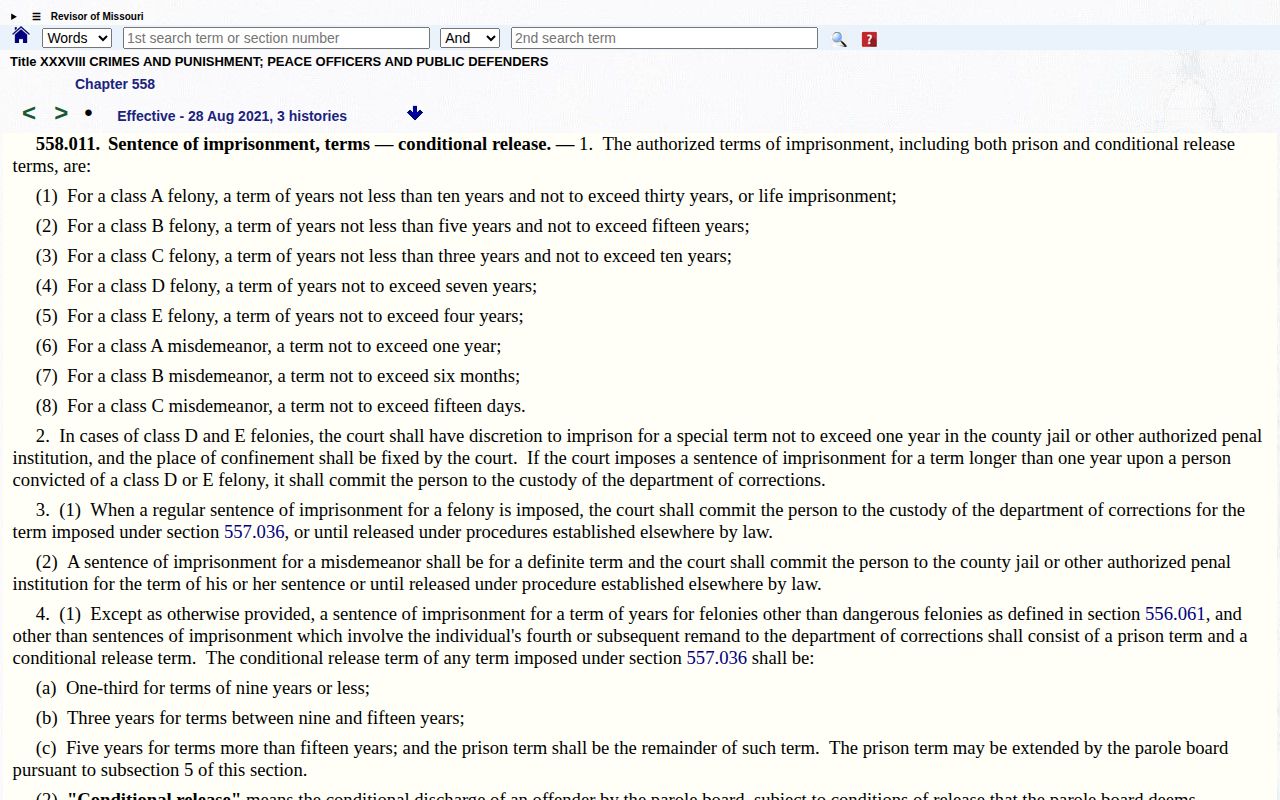
The statutory portions are one component of a calculation, not a promise that release will occur on the earliest possible day.
Jefferson County Minimum Prison Terms
Missouri’s 85-percent rule is not universal. Under RSMo § 558.019, a minimum prison term is the time that must be served before eligibility for parole, conditional release, or another early-release mechanism. A dangerous felony as defined by the cited law can require 85 percent, subject to the statute’s age-70 alternative after at least 40 percent and all exact conditions.
The same section contains other minimums for listed offenses tied to prior DOC commitments. One prior commitment can produce a 40-percent minimum, two can produce 50 percent, and three or more can produce 80 percent, within the statute’s scope and exceptions. Before using any percentage, establish the offense, offense date, statutory classification, and commitment history from authoritative records.
The official dangerous-felony minimum statute is shown below.
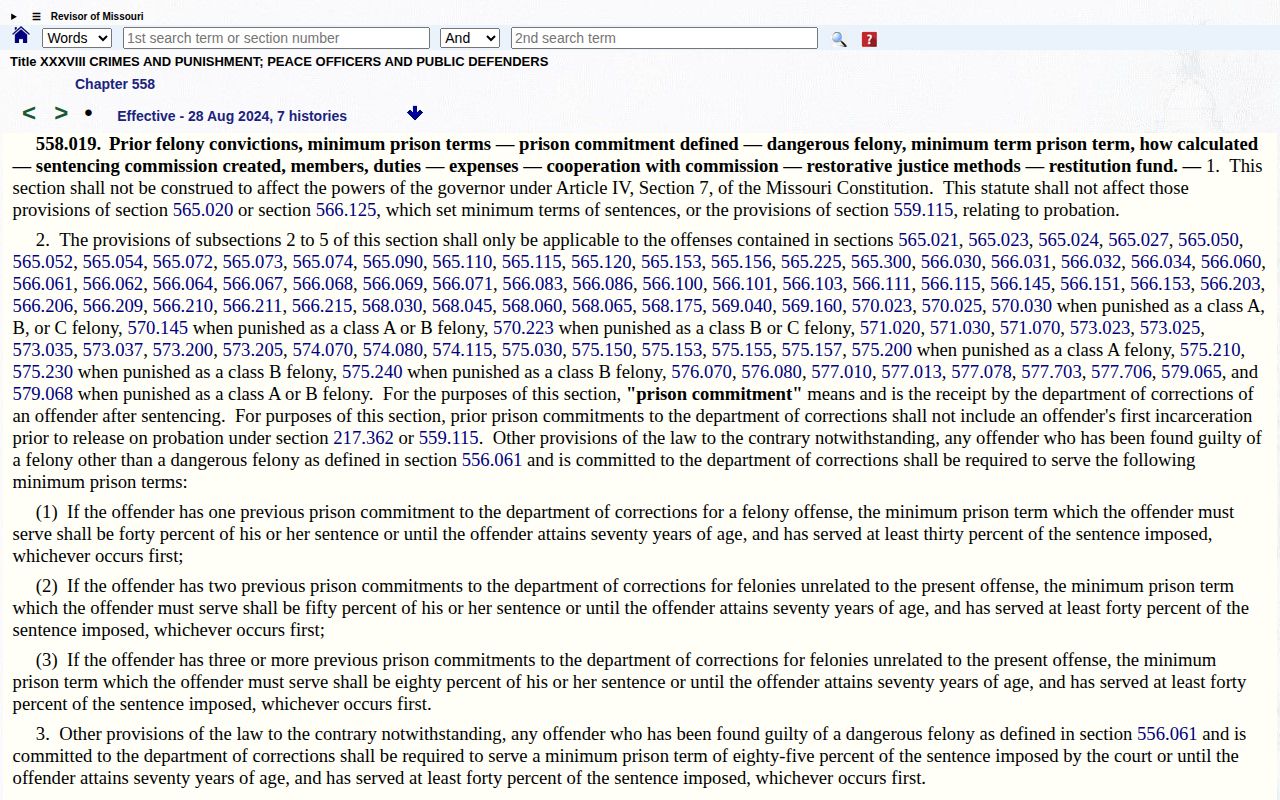
The captured text supports the narrow dangerous-felony rule. It does not support telling every Missouri prisoner to serve 85 percent.
Jefferson County Discretionary Good Time
RSMo § 558.041 allows eligible DOC-committed offenders to receive added good-time credit on the superintendent’s recommendation under a published Director policy. Orderly conduct and program participation can support an award. Violations can cause loss. Exclusions apply, and the credit concerns only the sentence currently being served.
Good time is discretionary. It should not be entered as an automatic subtraction before MODOC confirms an award. The Parole Board Blue Book also discusses administrative parole and time-credit release. A time-credit release date is the conditional-release date minus awarded credit, but a presumptive date still creates no automatic entitlement. Conduct, required programs, the release plan, new information, and sentence changes can move or rescind it.
The Missouri discretionary good-time rule shown here defines that limited authority.
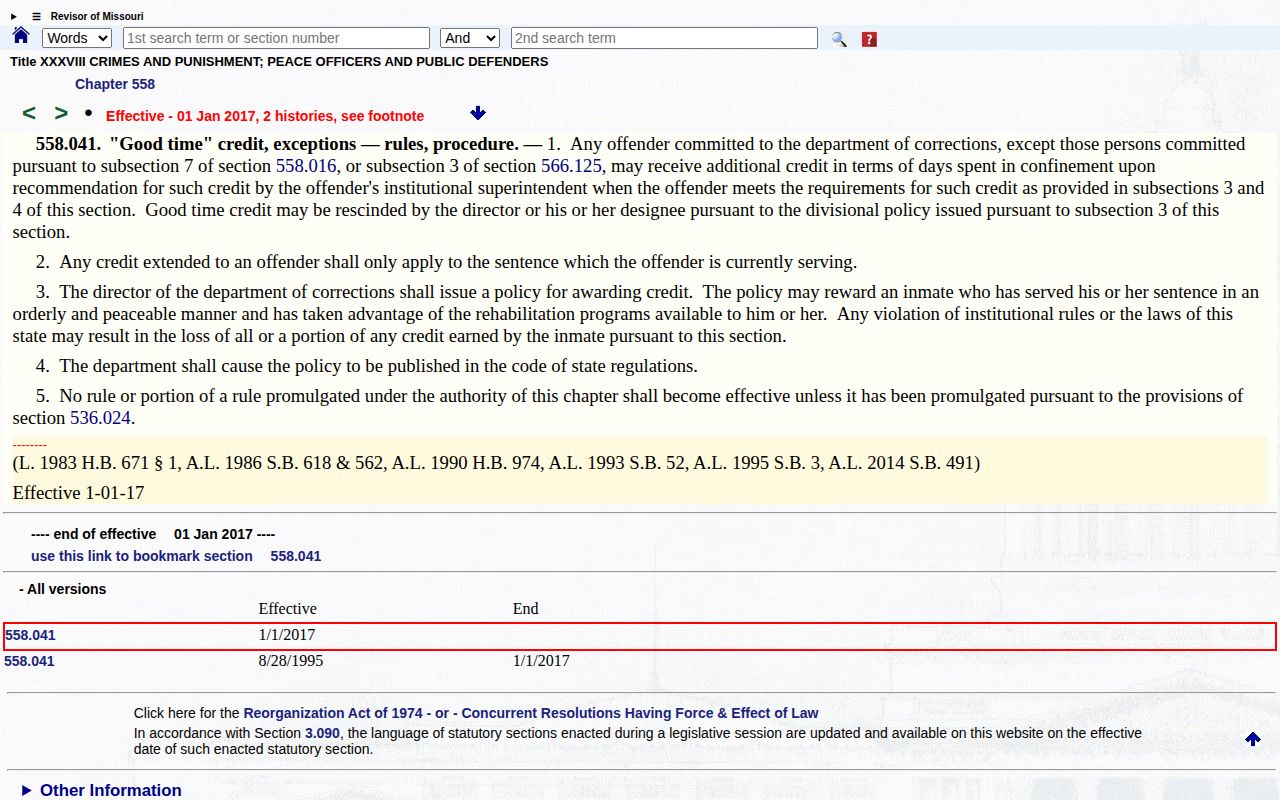
The source confirms that good time depends on eligibility and recommendation. It is not a county jail policy or a fixed statewide promise.
Why Jefferson County Release Dates Change
A release calculation reflects the facts known at that point. One new order or custody event can change the outcome. Compare the updated agency record with the earlier date rather than assuming that one must be an error.
| Factor | Possible effect on the date |
|---|---|
| Certified jail credit | Counts qualifying time already confined on the related matter |
| Good-time award or loss | Can change a time-credit calculation for an eligible DOC sentence |
| Parole Board decision | May set, deny, move, or rescind a presumptive release date within lawful authority |
| Detainer or hold | Can prevent community release or route the person to another custodian |
| Court order | May amend the sentence, custody credit, bond, or another controlling term |
| Concurrent or consecutive term | Changes whether sentences overlap or are served one after another |
| Violation or new custody | Can interrupt release plans or lead to revocation and return to custody |
A detainer is a request or legal basis for another authority to take custody. It explains why “released” from JCSO or MODOC may mean transfer rather than departure to the community. Ask for the releasing custodian, receiving agency, and event time when destination matters.
Five Missouri Release Date Mechanisms
Missouri has five mechanisms that are often blended into one false formula. Presentence jail credit under § 558.031 counts qualifying confinement already served. Discretionary DOC good time under § 558.041 can affect an eligible prison sentence after an award. Conditional release under § 558.011 defines a supervised community portion for qualifying sentences. Minimum terms under § 558.019 limit eligibility based on the exact offense and history.
The fifth mechanism operates later. Earned compliance under RSMo § 217.703 can shorten eligible probation or parole supervision after community supervision begins. It does not shorten the initial prison stay. An eligible person can earn credit for a full compliant calendar month, subject to exclusions, pauses, restitution, and other statutory conditions.
- Jail credit
- Time already spent in qualifying custody.
- Prison good time
- A discretionary credit for an eligible DOC sentence.
- Conditional release
- A supervised community part of an eligible sentence.
- Minimum prison term
- A threshold before specified release eligibility.
- Earned compliance
- Credit toward the end of eligible community supervision, not the first prison release.
Keeping these concepts separate prevents an early estimate from becoming an unsupported promise. The judgment, certified credit, MODOC calculation, Board action, and actual release record remain the working chain.
Confirm Jefferson County Actual Release
For a current state prisoner, ask the institutional caseworker about the calculated minimum and maximum dates and any Board action. The MODOC Sunshine data is useful for the exact date fields and historical rows, but it is working data refreshed nightly. Each charge produces a separate row. Group the rows by DOC ID and confirm that every relevant sentence is complete before drawing a conclusion.
A Completed Flag marked “Y” applies to that charge-level sentence row. It does not automatically prove that all custody or supervision ended. Once final discharge occurs, the public MODOC name search should not be expected to find the person. The Sunshine file, a focused DOC request, and the court judgment become the historical routes.
For Jefferson County Jail, use JCSO’s current roster for present custody and its rolling release page for a recent actual departure. If the entry has aged off, use the Sheriff’s records-request channel for the booking and release record. Register through the VINELink Release Check for available event alerts, but confirm the event with the custodian. A scheduled date, automated notification, court order, and actual release timestamp are four different forms of evidence.